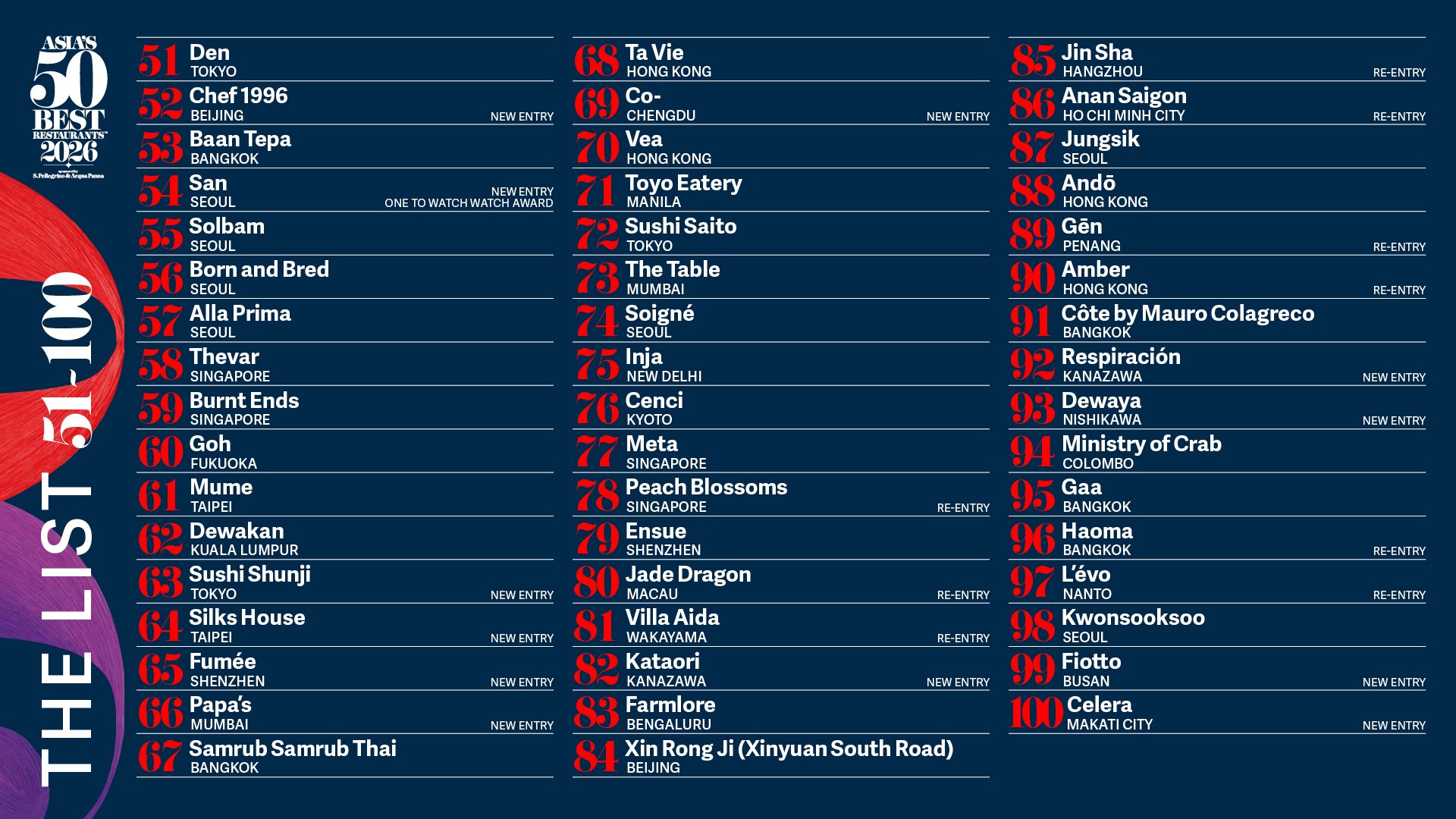
Asia’s 50 Best Restaurants has unveiled the extended 51–100 list for 2026, offering an early look at restaurants shaping the region’s dining landscape ahead of the main awards ceremony scheduled to take place in Hong Kong on 25 March 2026.
The list is compiled from votes cast by the Asia’s 50 Best Restaurants Academy, a panel of more than 350 industry professionals, including chefs, restaurateurs, food writers and culinary experts from across the region.
This year’s extended ranking features restaurants from 27 cities, four more than in 2025, reflecting the growing geographical diversity of Asia’s dining scene. The 2026 list also introduces 10 cities not represented last year, including four that appear for the first time: Busan, Chengdu, Kanazawa and Nishikawa.
A total of 12 restaurants make their debut on the 51–100 list, highlighting emerging culinary talent and evolving dining trends across Asia.
Seoul Leads the Extended Ranking
Seoul leads the list with seven restaurants, including new entry San (No.54), which was also named the 2026 One To Watch Award winner.
South Korea’s Busan also appears for the first time, with Fiotto (No.99) joining the ranking. The Italian restaurant, run by a husband-and-wife team, focuses on organic produce sourced from their family farm and offers dishes such as house-made pasta, cured ham and kombucha vinegar.
Japanese Cities Continue to Show Strength
Japan continues to feature prominently on the extended list. Tokyo records three restaurants, including new entrant Sushi Shunji (No.63), where chef Shunji Hashiba, a protégé of renowned sushi master Takashi Saito, serves his interpretation of Edomae-style sushi.
Two restaurants from Kanazawa debut this year: Kataori (No.82), known for its modern interpretation of kaiseki cuisine, and Respiración (No.92), created by three long-time chef collaborators whose cooking draws inspiration from Ferran Adrià’s El Bulli.
Nearby Nishikawa also joins the list with Dewaya (No.93), a historic mountain ryokan dating back to 1929 where chef Haruki Sato highlights seasonal mountain vegetables and regional ingredients.
New Entries Across China and Southeast Asia
The highest-ranked new entry on the list is Chef 1996 (No.52) in Beijing, an all-private-rooms restaurant. Other new entries from China include Fumée (No.65) in Shenzhen, where chef Reina Chen blends Chinese and French influences into what she describes as “glocal” cuisine.
In Chengdu, the intimate five-table restaurant Co- (No.69) joins the ranking for the first time, presenting tasting menus shaped by seasonal produce and the chef’s culinary travels.
Elsewhere in Asia, Silks House (No.64) in Taipei makes its debut with chef Max Wo’s refined Cantonese cuisine, while Papa’s (No.66) in Mumbai introduces a 12-seat tasting counter where chef Hussain Shahzad explores contemporary interpretations of Indian flavours.
Movement Across Southeast Asia
Several restaurants from Southeast Asia recorded notable movement on this year’s extended list. In Singapore, Thevar (No.58) climbed 12 places from No.70 in 2025, marking one of the most significant rises in the ranking, while Peach Blossoms (No.78) returned to the list.
In Bangkok, Haoma (No.96) re-enters the extended ranking, reinforcing the city’s continued presence in Asia’s dining scene.
Meanwhile, Dewakan (No.62) in Kuala Lumpur recorded the largest climb, rising 22 places from its previous position. Under chef Darren Teoh, the restaurant continues to explore indigenous Malaysian ingredients through contemporary techniques.
The Philippines also features on the list with Toyo Eatery (No.71) in Manila joined by new entrant Celera (No.100) in Makati City.
Looking Ahead to the Main Awards
A spokesperson for Asia’s 50 Best Restaurants said the extended ranking highlights the diversity and growth of the region’s culinary landscape.
“We are delighted to unveil this year’s 51–100 list, welcoming more outstanding establishments into this year’s extended ranking. The 51–100 list once again highlights the incredibly diverse and thriving culinary scene of the region, this year including restaurants from 27 cities, with 12 restaurants represented on the Asia’s 50 Best Restaurants list for the first time.”
The Asia’s 50 Best Restaurants 2026 list will be announced during the awards ceremony in Hong Kong on 25 March 2026, held in collaboration with the Hong Kong Tourism Board. The event will also be live-streamed on the 50 Best YouTube channel at 20:00 Hong Kong time.
The voting process is independently adjudicated by Deloitte, the official independent adjudication partner for the awards, to ensure the integrity of the results.
Asia's 50 Best Restaurants 2025 Top 51-100
Den, Tokyo
Chef 1996, Beijing
Baan Tepa, Bangkok
San, Seoul
Solbam, Seoul
Born and Bred, Seoul
Alla Prima, Seoul
Thevar, Singapore
Burnt Ends, Singapore
Goh, Fukuoka
Mume, Taipei
Dewakan, Kuala Lumpur
Sushi Shunji, Tokyo
Silks House, Taipei
Fumée, Shenzhen
Papa’s, Mumbai
Samrub Samrub Thai, Bangkok
Ta Vie, Hong Kong
Co-, Chengdu
Vea, Hong Kong
Toyo Eatery, Manila
Sushi Saito, Tokyo
The Table, Mumbai
Soigné, Seoul
Inja, New Delhi
Cenci, Kyoto
Meta, Singapore
Peach Blossoms, Singapore
Ensue, Shenzhen
Jade Dragon, Macau
Villa Aida, Wakayama
Kataori, Kanazawa
Farmlore, Bengaluru
Xin Rong Ji (Xinyuan South Road), Beijing
Jin Sha, Hangzhou
Anan Saigon, Ho Chi Minh City
Jungsik, Seoul
Andō, Hong Kong
Gēn, Penang
Amber, Hong Kong
Côte by Mauro Colagreco, Bangkok
Respiración, Kanazawa
Dewaya, Nishikawa
Ministry of Crab, Colombo
Gaa, Bangkok
Haoma, Bangkok
L’évo, Nanto
Kwonsooksoo, Seoul
Fiotto, Busan
Celera, Makati City